Jump to: Skinterview | Related Links
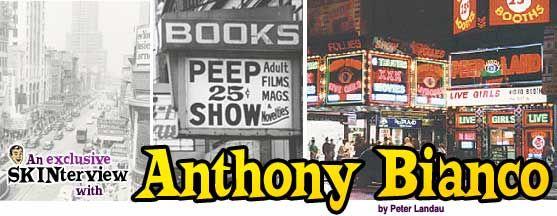
Times Square, the legendary entertainment mecca in the heart of New York City, turned 100 on April 8, 2004, which begs the question: Does the old girl still have a few tricks left in her?
Well, maybe on the Minnesota Strip, which is that part of midtown Eighth Avenue where hookers, freaks, pimps, perverts, sex fiends, and all other manner of terribly thrilling lowlife famously grazed like cattle from the late 1960s to the early 1990s.
Nowadays Times Square's main attraction is family-oriented thrills. But the Golden Age of Getting It On can be relived thanks to dispatches from those who were there, such as Josh Alan Friedman's Tales of Times Square (Feral House) and Sleazoid Express: A Mind-Twisting Tour Through the Grindhouse Cinema of Times Square (Fireside) by Bill Landis and Michelle Clifford.
To celebrate the anniversary, two well-researched histories of the Crossroads of the World have recently been published. James Traub penned a measured tome, The Devil's Playground: A Century of Pleasure and Profit in Times Square (Random House), but at Skin Central Ghosts of 42nd Street: A History of America's Most Infamous Block (William Morrow) by Anthony Bianco is the go-to book for the gonad-pleasing queasy details.
The BusinessWeek senior writer took some time off to speak with Mr. Skin and discuss the heyday of The Deuce, which was '68 to '86, when the grindhouse was king. After that the theaters were shuttered and only a few lucky ones saved by the massive redevelopment that has returned 42nd Street to its past glory--though, sadly, without any glory holes.
So, genital reader, come and meet those dancing teats, on the avenue we're taking you to, 42nd Street.
Where did the term grindhouse come from?
The first grinder was the Rialto. The origin of the term is a little vague. That it has nothing to do with bump-and-grind I think is pretty clear. It's the continuous grind of showing the films, the grindingly continuous schedule of movies that show almost 24 hours a day--and in some cases 24 hours a day.
Who coined the term first, I'm not sure. It sort of pops up at a certain point in the coverage without explanation. I never saw the derivation of it explained. I think it may have been coined later when The Street started to deteriorate and there became a connotation with bump-and-grind, maybe.
It does have an almost criminal-lingo slang to it.
That would be my suspicion, that it happened probably quite a bit after the time when this mode of movie exhibition was established.
When did the grinders first start operating?
The Rialto was built as a great movie palace. It essentially failed and Arthur Meyer acquired it from, I think, Paramount and changed the basis of it in the Depression, in the '30s.
A lot of his earliest customers were unemployed men who needed a place to hide out for the day while either they pretended to look for a job or were so disgusted with trying to find a job and not finding one that they just wanted to hang out in a movie theater. So he started showing movies on a continuous basis, which really is the essence of a grinder.
And then the Brandt family, which owned most of the 42nd Street theaters, adopted the same policy one after one, mainly in the '40s, as they acquired theaters that had been playhouses and started showing movies.
As The Street went more down market, vis-a-vis the rest of the city, the showing schedules lengthened, so you had the heyday of the grinder in the '40s and '50s, as I understand it.
Was it the '50s when the Apollo--not the famous performance hall in Harlem, but a movie house on 42nd Street with the same name--started showing foreign movies and nudity first reared its salacious head in Stateside cinema?
The Brandts, since they owned about eight theaters on 42nd Street, they had to find a way to differentiate them one from another, and the Apollo was the foreign film theater, I think starting in the '40s.
As foreign films were allowed to take liberties that American films weren't, you probably had the first sexual-oriented films appearing in that high-minded guise of foreign films.
You also had subtitles, so they attracted an audience of people with more risqu?astes and deaf people [laughs]. They were probably the first subtitles. There are a number of columns you see from the '40s marveling at the number of deaf people standing outside the Apollo without really understanding why they were there.
I don't know to what extent it was an attempt to get in under censorship and show sexually risqu?ilms as much as it was an attempt to create a market identity for each of their theaters.
Did that create the domino effect that leveled all theaters to the smut line?
There was a lot of really incremental evolution. Things happened slowly and gradually. In terms of the X-rated stuff, I think in the beginning, in the '40s and the '50s, it was really led by the bookstores.
But by the late '60s you had an element of the Brandt family, Bingo Brandt and Lewis Brandt, that really started to bring X-rated films to The Street at the Rialto and the Rialto 2.
It's really the late '60s that that starts to attract a lot of attention and they develop a real reputation for showing sex films on 42nd Street. Before that time you won't find much about it.
This is about the same time that Marty Hodas hit The Street in '65, '66 with the peep machines for a quarter. You had some permissive Supreme Court rulings and also in the State of New York, as well as other places. Marty Hodas came out of the vending-machine industry, and so he was looking for something new.
There was a lot of entrepreneurial energy coming out of Hodas and some other people who were shifting from other businesses into 42nd Street porn as it broke open. It really exploded in the late '60s; a tremendous amount of money and outer-borough operators move in behind Hodas. And he had some film production going that was generated by the peep shows. But I don't think he was distributing to the grindhouse theaters; it was all for his own peep shows.
Is that vertical or horizontal integration [laughs]? Most appropriately it would be horizontal.
Was it Hodas who make the leap to live, windowless peeps--where customers could not only look at a naked girl but reach through and grab a mittful of flesh for a couple of bucks?
I believe Hodas was a follower there. There's this guy named Garrett Williams, who I believe is the first one who did the live peep show sometime in the late '60s. Hodas was not the innovator there, but he was a customer [laughs]. And then he also adapted it for his own live peep show.
But I think even he gave credit to Garrett Williams. It's amazing how fast things would spread once you had a new idea because you had such a concentration of establishments there in that few block area that new ideas would spread like crazy--far beyond the ability of the police or any other regulator to keep track of it. It was a real hotbed of sexual innovation.
Do you think Times Square proved there was an audience for exploitation and that it opened the doors for Hollywood to produce their big-budget versions of Texas Chainsaw Massacre and Dawn of the Dead?
What was fringe then in some ways is becoming mainstream, and Texas Chainsaw Massacre is a good example of that.
The whole ethos there, it was really distinctive. It was definitely one of the more unusual places in New York City, and it had a real following of people who loved the place and then a majority of people who dreaded it, would stay away from it. It wasn't quite underground, but it was underground-like.
The commercial mainstream has a way of co-opting and incorporating things on the fringe, whatever they are, turning it into commerce. You can say that the out-of-the-mainstream fringe kind of movie that thrived on 42nd Street has been incorporated into the mainstream.
The difference is that there's no physical place, no street, where you can go to really immerse yourself in that sort of film experience. You can go to some chain theater and watch the latest version of Texas Chainsaw Massacre, but you can't go to a place that embodies that kind of world and spend an afternoon or a night there. It's been incorporated or co-opted or it's disappeared.
You also have the rise of video and the segmenting of markets, so it was possible to make money out of fringe areas that before might have been ignored by Hollywood. You have the emergence of video at the same time, which of course was a very mixed thing for 42nd Street. You had a new form of distribution, which made that place even more old fashioned and cost it some of its market.
Did your research touch on one of the darker corners of The Deuce's meat market, the Harem? This hole-in-the-wall auditorium was dubbed in Tales of Times Sqaure as "the sleaziest theater in America."
That was a Marty Hodas place. I had some great stuff on the Harem that I had to cut out of the book.
Marty Hodas owned the building. He struck up a relationship with these two low-life characters named George Kaplan and Jerry "The Nit" Gomberg. These are guys he met on 42nd Street and they were among the cast of characters, hustlers who hung out looking for opportunity.
Marty Hodas was smart enough to use his profits to buy property, so he became a landlord to a number of people. He rented the Harem, or whatever the building was called first, to these two guys--Gomberg and Kaplan--and they opened a number of massage parlors. Hodas didn't really want to go into that business, but he didn't mind leasing space to them.
The Harem was so notorious that it attracted immediate attention from the police. There was a sting there. Gomberg and Kaplan made the mistake of hiring an undercover police officer who came in for a job interview, obviously not wearing her uniform, and they hired her. The place was busted really fast.
Like all these places, they kept reopening because there really wasn't any good reason to shut them down. Obviously prostitution is illegal, but it was hard to prove. Although they were offending popular tastes, they weren't really breaking the law. They would find building-code violations and health-code violations and things like that, but if they were corrected they could open up again.
The Harem bothered the police. Hodas, I believe, kept it for a long time and went through many different tenants of this sort but didn't actually operate the place himself.
What's Hodas doing now?
He lives out in Long Island and has some X-rated places in Florida. I don't know if he has anything left in New York. He had something right across from Port Authority. The area where he had his last store, I believe, was condemned as a site for The New York Times headquarters. That was the last refuse of Marty Hodas in Times Square.
Tell me about Richard Basciano and Show World, the four-level mecca of peep shows and live nude girls that was once labeled by The New York Times as "the McDonald's of sex."
Basciano and Hodas were the two most significant porn retailers in this history. Basciano is really shrewd. He's much smarter and more disciplined than Hodas. He opened Show World sometime in the late '70s. It was such a leap beyond the other outlets that existed at the time, it was a supermarket of porn and well maintained, clean [laughs].
He had his own tokens. He was a league beyond his competitors in terms of marketing, and he was very shrewd in dealing with his mob partners and the police.
I think he was the first to introduce video peep machines where you had a range of choice. He had live stuff there that was part of the mix. It was an emporium of porn. Have you ever been in there?
I have, and I saw things that no man should ever have to see.
That sounds more like Peep World [another sex marketplace within a few hundred feet of Show World].
They all blend together.
I did talk to a woman who worked at a lot of these places in Times Square, she sort of respected Basciano. He was all business.
You know, a lot of these guys were in it for the girls really [laughs]. He was all business: They had W-2 forms and employee applications to fill out and he didn't mess with them.
[This woman who worked there] respected that, because it was not the norm around Times Square where you're expected to do double duty.
Basciano is a very low-profile guy, it's impossible to get to talk to him. I didn't talk to him. He's a boxer who had a boxing ring above Show World. I think it's still there, a gymnasium where he'd work out.
Now it's a comedy club and has an off-off-Broadway stage, side by side with the peeps.
Show World exists just outside of the urban renewal boundary, so that didn't affect it. [New York City ex-Mayor] Giuliani then made several attempts to drive him and other people out of business by regulating the content of what they sell.
You could stay in business if you devoted I think sixty percent to non-X-rated stuff. Whatever the game was they would comply.
Show World still has some alternative films and theatrical performance and it's still in business.

Well, maybe on the Minnesota Strip, which is that part of midtown Eighth Avenue where hookers, freaks, pimps, perverts, sex fiends, and all other manner of terribly thrilling lowlife famously grazed like cattle from the late 1960s to the early 1990s.
Nowadays Times Square's main attraction is family-oriented thrills. But the Golden Age of Getting It On can be relived thanks to dispatches from those who were there, such as Josh Alan Friedman's Tales of Times Square (Feral House) and Sleazoid Express: A Mind-Twisting Tour Through the Grindhouse Cinema of Times Square (Fireside) by Bill Landis and Michelle Clifford.
To celebrate the anniversary, two well-researched histories of the Crossroads of the World have recently been published. James Traub penned a measured tome, The Devil's Playground: A Century of Pleasure and Profit in Times Square (Random House), but at Skin Central Ghosts of 42nd Street: A History of America's Most Infamous Block (William Morrow) by Anthony Bianco is the go-to book for the gonad-pleasing queasy details.
The BusinessWeek senior writer took some time off to speak with Mr. Skin and discuss the heyday of The Deuce, which was '68 to '86, when the grindhouse was king. After that the theaters were shuttered and only a few lucky ones saved by the massive redevelopment that has returned 42nd Street to its past glory--though, sadly, without any glory holes.
So, genital reader, come and meet those dancing teats, on the avenue we're taking you to, 42nd Street.
Where did the term grindhouse come from?
The first grinder was the Rialto. The origin of the term is a little vague. That it has nothing to do with bump-and-grind I think is pretty clear. It's the continuous grind of showing the films, the grindingly continuous schedule of movies that show almost 24 hours a day--and in some cases 24 hours a day.
Who coined the term first, I'm not sure. It sort of pops up at a certain point in the coverage without explanation. I never saw the derivation of it explained. I think it may have been coined later when The Street started to deteriorate and there became a connotation with bump-and-grind, maybe.
It does have an almost criminal-lingo slang to it.
That would be my suspicion, that it happened probably quite a bit after the time when this mode of movie exhibition was established.
When did the grinders first start operating?
The Rialto was built as a great movie palace. It essentially failed and Arthur Meyer acquired it from, I think, Paramount and changed the basis of it in the Depression, in the '30s.
A lot of his earliest customers were unemployed men who needed a place to hide out for the day while either they pretended to look for a job or were so disgusted with trying to find a job and not finding one that they just wanted to hang out in a movie theater. So he started showing movies on a continuous basis, which really is the essence of a grinder.
And then the Brandt family, which owned most of the 42nd Street theaters, adopted the same policy one after one, mainly in the '40s, as they acquired theaters that had been playhouses and started showing movies.
As The Street went more down market, vis-a-vis the rest of the city, the showing schedules lengthened, so you had the heyday of the grinder in the '40s and '50s, as I understand it.
Was it the '50s when the Apollo--not the famous performance hall in Harlem, but a movie house on 42nd Street with the same name--started showing foreign movies and nudity first reared its salacious head in Stateside cinema?
The Brandts, since they owned about eight theaters on 42nd Street, they had to find a way to differentiate them one from another, and the Apollo was the foreign film theater, I think starting in the '40s.
As foreign films were allowed to take liberties that American films weren't, you probably had the first sexual-oriented films appearing in that high-minded guise of foreign films.
You also had subtitles, so they attracted an audience of people with more risqu?astes and deaf people [laughs]. They were probably the first subtitles. There are a number of columns you see from the '40s marveling at the number of deaf people standing outside the Apollo without really understanding why they were there.
I don't know to what extent it was an attempt to get in under censorship and show sexually risqu?ilms as much as it was an attempt to create a market identity for each of their theaters.
Did that create the domino effect that leveled all theaters to the smut line?
There was a lot of really incremental evolution. Things happened slowly and gradually. In terms of the X-rated stuff, I think in the beginning, in the '40s and the '50s, it was really led by the bookstores.
But by the late '60s you had an element of the Brandt family, Bingo Brandt and Lewis Brandt, that really started to bring X-rated films to The Street at the Rialto and the Rialto 2.
It's really the late '60s that that starts to attract a lot of attention and they develop a real reputation for showing sex films on 42nd Street. Before that time you won't find much about it.
This is about the same time that Marty Hodas hit The Street in '65, '66 with the peep machines for a quarter. You had some permissive Supreme Court rulings and also in the State of New York, as well as other places. Marty Hodas came out of the vending-machine industry, and so he was looking for something new.
There was a lot of entrepreneurial energy coming out of Hodas and some other people who were shifting from other businesses into 42nd Street porn as it broke open. It really exploded in the late '60s; a tremendous amount of money and outer-borough operators move in behind Hodas. And he had some film production going that was generated by the peep shows. But I don't think he was distributing to the grindhouse theaters; it was all for his own peep shows.
Is that vertical or horizontal integration [laughs]? Most appropriately it would be horizontal.
Was it Hodas who make the leap to live, windowless peeps--where customers could not only look at a naked girl but reach through and grab a mittful of flesh for a couple of bucks?
I believe Hodas was a follower there. There's this guy named Garrett Williams, who I believe is the first one who did the live peep show sometime in the late '60s. Hodas was not the innovator there, but he was a customer [laughs]. And then he also adapted it for his own live peep show.
But I think even he gave credit to Garrett Williams. It's amazing how fast things would spread once you had a new idea because you had such a concentration of establishments there in that few block area that new ideas would spread like crazy--far beyond the ability of the police or any other regulator to keep track of it. It was a real hotbed of sexual innovation.
Do you think Times Square proved there was an audience for exploitation and that it opened the doors for Hollywood to produce their big-budget versions of Texas Chainsaw Massacre and Dawn of the Dead?
What was fringe then in some ways is becoming mainstream, and Texas Chainsaw Massacre is a good example of that.
The whole ethos there, it was really distinctive. It was definitely one of the more unusual places in New York City, and it had a real following of people who loved the place and then a majority of people who dreaded it, would stay away from it. It wasn't quite underground, but it was underground-like.
The commercial mainstream has a way of co-opting and incorporating things on the fringe, whatever they are, turning it into commerce. You can say that the out-of-the-mainstream fringe kind of movie that thrived on 42nd Street has been incorporated into the mainstream.
The difference is that there's no physical place, no street, where you can go to really immerse yourself in that sort of film experience. You can go to some chain theater and watch the latest version of Texas Chainsaw Massacre, but you can't go to a place that embodies that kind of world and spend an afternoon or a night there. It's been incorporated or co-opted or it's disappeared.
You also have the rise of video and the segmenting of markets, so it was possible to make money out of fringe areas that before might have been ignored by Hollywood. You have the emergence of video at the same time, which of course was a very mixed thing for 42nd Street. You had a new form of distribution, which made that place even more old fashioned and cost it some of its market.
Did your research touch on one of the darker corners of The Deuce's meat market, the Harem? This hole-in-the-wall auditorium was dubbed in Tales of Times Sqaure as "the sleaziest theater in America."
That was a Marty Hodas place. I had some great stuff on the Harem that I had to cut out of the book.
Marty Hodas owned the building. He struck up a relationship with these two low-life characters named George Kaplan and Jerry "The Nit" Gomberg. These are guys he met on 42nd Street and they were among the cast of characters, hustlers who hung out looking for opportunity.
Marty Hodas was smart enough to use his profits to buy property, so he became a landlord to a number of people. He rented the Harem, or whatever the building was called first, to these two guys--Gomberg and Kaplan--and they opened a number of massage parlors. Hodas didn't really want to go into that business, but he didn't mind leasing space to them.
The Harem was so notorious that it attracted immediate attention from the police. There was a sting there. Gomberg and Kaplan made the mistake of hiring an undercover police officer who came in for a job interview, obviously not wearing her uniform, and they hired her. The place was busted really fast.
Like all these places, they kept reopening because there really wasn't any good reason to shut them down. Obviously prostitution is illegal, but it was hard to prove. Although they were offending popular tastes, they weren't really breaking the law. They would find building-code violations and health-code violations and things like that, but if they were corrected they could open up again.
The Harem bothered the police. Hodas, I believe, kept it for a long time and went through many different tenants of this sort but didn't actually operate the place himself.
What's Hodas doing now?
He lives out in Long Island and has some X-rated places in Florida. I don't know if he has anything left in New York. He had something right across from Port Authority. The area where he had his last store, I believe, was condemned as a site for The New York Times headquarters. That was the last refuse of Marty Hodas in Times Square.
Tell me about Richard Basciano and Show World, the four-level mecca of peep shows and live nude girls that was once labeled by The New York Times as "the McDonald's of sex."
Basciano and Hodas were the two most significant porn retailers in this history. Basciano is really shrewd. He's much smarter and more disciplined than Hodas. He opened Show World sometime in the late '70s. It was such a leap beyond the other outlets that existed at the time, it was a supermarket of porn and well maintained, clean [laughs].
He had his own tokens. He was a league beyond his competitors in terms of marketing, and he was very shrewd in dealing with his mob partners and the police.
I think he was the first to introduce video peep machines where you had a range of choice. He had live stuff there that was part of the mix. It was an emporium of porn. Have you ever been in there?
I have, and I saw things that no man should ever have to see.
That sounds more like Peep World [another sex marketplace within a few hundred feet of Show World].
They all blend together.
I did talk to a woman who worked at a lot of these places in Times Square, she sort of respected Basciano. He was all business.
You know, a lot of these guys were in it for the girls really [laughs]. He was all business: They had W-2 forms and employee applications to fill out and he didn't mess with them.
[This woman who worked there] respected that, because it was not the norm around Times Square where you're expected to do double duty.
Basciano is a very low-profile guy, it's impossible to get to talk to him. I didn't talk to him. He's a boxer who had a boxing ring above Show World. I think it's still there, a gymnasium where he'd work out.
Now it's a comedy club and has an off-off-Broadway stage, side by side with the peeps.
Show World exists just outside of the urban renewal boundary, so that didn't affect it. [New York City ex-Mayor] Giuliani then made several attempts to drive him and other people out of business by regulating the content of what they sell.
You could stay in business if you devoted I think sixty percent to non-X-rated stuff. Whatever the game was they would comply.
Show World still has some alternative films and theatrical performance and it's still in business.